

The best UX design agencies for AI products combine user research, information architecture, interaction design, interactive prototyping, usability testing, and design systems into a repeatable process. That process gets harder when the product is built on AI: the interface has to handle probabilistic outputs, explain what the system is doing, and earn user trust. This guide evaluates 11 established US firms on those technical dimensions, plus the two factors that decide whether an AI product actually ships — how well each team validates design with real users, and how clearly it connects design decisions to measurable business outcomes.
The best UX design agencies for AI products in the US include Punchcut, IDEO, frog, Work & Co, Blink UX, Method, Designit, MetaLab, Huge, Code and Theory, and ustwo. The right choice depends on the agency’s research practice, industry experience, product-development capabilities, communication model, project cost, and ability to connect design decisions to measurable business goals.
Building an AI product changes the design problem. The system is non-deterministic, so the interface cannot be designed against a fixed set of screens. The model generates outputs in real time, which means information architecture, user flows, and error states all have to account for variability. And the user has to trust a system that may give a different answer on different days. Agencies that handle this well share three traits: they run generative research to find the right problem, they test prototypes against live models and representative users, and they build design systems flexible enough to contain AI-generated content. Digital.gov’s user research guide frames the first two; Nielsen Norman Group’s research cheat sheet maps the full method stack.
The Best UX Design Agencies for AI Products at a Glance
| Rank | Agency | Best for | Core strengths | Typical AI-product fit |
| 1 | Punchcut | Future-facing product and experience innovation | User research, product strategy, complex interfaces, prototyping, design systems | Enterprise and growth-stage teams designing intelligent, immersive, or multi-device products |
| 2 | IDEO | Human-centered innovation and organizational change | Research, design strategy, service design, venture and transformation work | Leaders defining new offerings or reframing complex systems |
| 3 | frog | Connected brand, product, and service experiences | Strategy, product design, service design, brand experience | Large organizations connecting physical and digital touchpoints |
| 4 | Work & Co | High-profile digital products and platforms | Product strategy, design, technology, launch execution | Organizations seeking a senior integrated product team |
| 5 | Blink UX | Research-intensive product decisions | User research, usability testing, product design | Teams that need evidence before or during design |
| 6 | Method | Enterprise product and service transformation | Strategy, product design, engineering collaboration | Complex organizations modernizing services and platforms |
| 7 | Designit | Large-scale change and service design | Research, strategy, experience design, organizational change | Global enterprises managing transformation across teams and markets |
| 8 | MetaLab | Fast-moving digital product launches | Product strategy, UI/UX design, prototyping | Startups, scale-ups, and product teams seeking a polished launch |
| 9 | Huge | Connected customer experiences and brand platforms | Experience strategy, design, technology, marketing | Enterprises joining product, brand, and customer-experience work |
| 10 | Code and Theory | Content-rich platforms and digital ecosystems | Product design, engineering, data, platform strategy | Media, publishing, commerce, and complex digital platforms |
| 11 | ustwo | Digital products with strong product-team collaboration | Product strategy, service design, product design, delivery | Organizations building or improving customer-facing products |
“Best for” labels are editorial summaries, not universal rankings. Capabilities and team structures change, so confirm the proposed team and scope during consultation.
How we selected our top AI product design agencies
We used the same seven criteria for every firm. Industry reputation matters, but only when it is supported by relevant expertise, current case studies, and a process that fits your project. A famous agency can still be the wrong fit if its specialization, staffing model, or preferred engagement size does not match the work.
- UX specialization and depth. Evidence of user research, information architecture, interaction design, prototyping, usability testing, and design systems.
- Relevant experience. Documented work on digital products, platforms, services, mobile applications, enterprise tools, or complex workflows.
- Research-to-design process. A structured method that turns user research data into design decisions and validates assumptions with real users.
- Client collaboration. Clear participation for stakeholders, client teams, product leaders, developers, and an in-house design team.
- Business alignment. The ability to connect user needs and user satisfaction to adoption, efficiency, retention, conversion, or other business goals.
- Delivery fit. Appropriate capabilities for the project requirements, including design-only work, development support, app development, web development, or broader digital transformation.
- Evidence quality. Case studies that explain the problem, process, iterations, and outcome rather than showing final screens alone.
For AI products specifically, add these four checks:
- Interaction-model fit. Does the team have experience designing for non-deterministic outputs, conversational prompts, or multi-modal interfaces?
- Trust and explainability. Can the team design an interface that shows users what the system is doing and why, without burying the answer in jargon?
- Prototyping against live models. Does the agency test with a real model or a working ML pipeline, not just static mockups?
- Flexible design systems. Do the components and patterns tolerate variable content, loading states, uncertainty, and changing outputs?
A strong portfolio case study should show the business and user problem, the research methods and findings, how assumptions changed, the user flows and information architecture, the design iterations and usability testing, the final interface, and any measurable outcomes the client permits. Agency specialization can greatly impact the delivery of a UX design project, and evaluating agencies on expertise is the only way to tell whether a firm fits.
The 11 Top UX design agencies for AI Products
1. Punchcut: Best for intelligent systems and complex digital experiences
Image: Punchcut
Punchcut is a UX design and innovation firm that has worked on emerging-technology interfaces since 2002, partnering with enterprise clients and growth-stage product teams. It concentrates on human-centered design for AI, intelligent systems, automotive, mobile, and multi-device experiences where the interaction model does not yet exist. The work spans user research, opportunity definition, product strategy, user flows, interactive prototyping, usability testing, interface design, and design systems.
Six capabilities define the specialism:
- AI-native design systems. Component libraries, patterns, and governance rules built for model-generated content rather than static screens, specifying how variable outputs, confidence states, loading behavior, and error handling behave.
- Agentic workflows. Designing for systems that act on the user’s behalf across multiple steps, which requires mapping user intent, tool boundaries, approval points, and failure states into a workflow a person can follow and override.
- Autonomy. Defining graduated autonomy levels and designing the interface cues that make a shift in control legible rather than alarming.
- Research. Generative research to find the right problem and evaluative research to test the proposed experience, including an original study of more than 1,000 technology consumers on AI expectations through its human-centered AI consulting practice.
- AI design engineering. Prototyping against live models and working pipelines so design decisions are tested against real model behavior, not static mockups.
- AI-native processes. Using AI inside its own workflow to speed research synthesis, design variants, and pattern exploration, so more budget goes to the judgment work AI cannot do. That extends to designing for generative UI, where the interface is assembled by a model in real time.
Its experience design agency work embeds senior designers into client teams to move from an ambiguous product opportunity to a tested experience direction, often within six to twelve weeks.
Best for: Established businesses and product teams designing new interaction models, intelligent systems, connected products, or complex workflows.
Fit consideration: Buyers seeking a commodity web design package, social media marketing, or simple graphic design production should use a specialist in those services instead.
Clients: Google, Amazon AWS, Samsung, Salesforce, Meta, Visa, Capital One
2. IDEO: Best for human-centered innovation strategy
Image: IDEO
IDEO is the firm that made human-centered design widely known, and it remains a strong option for organizations facing ill-defined product, service, or organizational problems. The practice combines research, design strategy, service design, and venture work, with a method that reframes a problem before proposing a solution. IDEO fits when leadership needs help deciding what to build, not just how to design it — which makes it a useful first partner for teams exploring an AI concept before they commit to a build.
Best for: Organizations defining new services, business models, or transformation programs before committing to a build.
Fit consideration: Confirm how much implementation, software development, and post-launch support are included.
Clients: IHG Hotels & Resorts, Sanofi, Boom Supersonic, Jack Technology
3. frog: Best for connected products, services, and brand experiences
Image: Frog Design
frog works across product, service, and brand experience, and it is strongest where the three need to behave as one system. For large organizations with connected ecosystems, multiple touchpoints, or cross-market service design needs, frog brings strategy and design that spans physical and digital platforms. That matters for AI products that sit at the center of a connected ecosystem, where the experience has to work across a device, an app, and a brand touchpoint.
Best for: Large organizations with connected ecosystems, multiple touchpoints, or cross-market service design needs.
Fit consideration: Confirm the specific studio, delivery team, and level of specialist involvement.
Clients: IKEA (Ingka Group), Tiffany & Co., Nestlé Purina, Odeabank
4. Work & Co: Best for design-led product delivery
Image: Bork & Co
Work & Co is an integrated design and technology partner that builds and launches major digital products. Its practice areas cover product strategy, user research and testing, UX/UI design, design systems, accessibility, full-stack mobile and web development, and technical architecture. That combination makes it a fit for organizations that want strategy, design, and technology execution held closely together under one team rather than handed across multiple vendors. For AI products, this means the design and the model integration move in the same sprint, not in sequence.
Best for: Organizations that want strategy, product design, and technology execution held closely together.
Fit consideration: Ask how research, accessibility, and post-launch optimization are scoped alongside product delivery.
Clients: Gatorade, Apple, Google, Nike, IKEA, MTA
5. Blink UX: Best for user research and usability testing
Image: Blink UX
Blink UX is a research-led product design firm, and it is the strongest fit on this list for teams that need evidence before committing to a design direction. The practice centers on user research, usability testing, field work, and translating user research data into product recommendations and interface design. For AI products, this research depth is a real advantage: it is the fastest way to learn whether users trust a recommendation, understand a confidence indicator, or abandon the product when the output is ambiguous.
Best for: Teams validating a concept, diagnosing an existing product, or reducing risk before development.
Fit consideration: Confirm whether the engagement ends with findings or continues through detailed UX/UI design and implementation support.
Clients: NASA, JPMorgan Chase, Google, Amazon, Microsoft, Meta
6. Method: Best for enterprise product and service transformation
Image: Method
Method is a strategic design partner for complex products, services, and organizational change. It works with enterprises modernizing digital services, internal tools, or cross-channel customer experiences, where the challenge is as much about aligning stakeholders as designing screens. For enterprise AI efforts, that matters: the biggest failure mode is not the model but the change management around it, which includes decision rights between the agency, business stakeholders, the in-house design team, and engineering.
Best for: Enterprise teams modernizing digital services, internal tools, or cross-channel customer experiences.
Fit consideration: Define decision rights between Method, business stakeholders, the in-house design team, and engineering.
Clients: MetLife, Ben & Jerry’s, thyssenkrupp, Cegid
7. Designit: Best for large-scale change across client teams
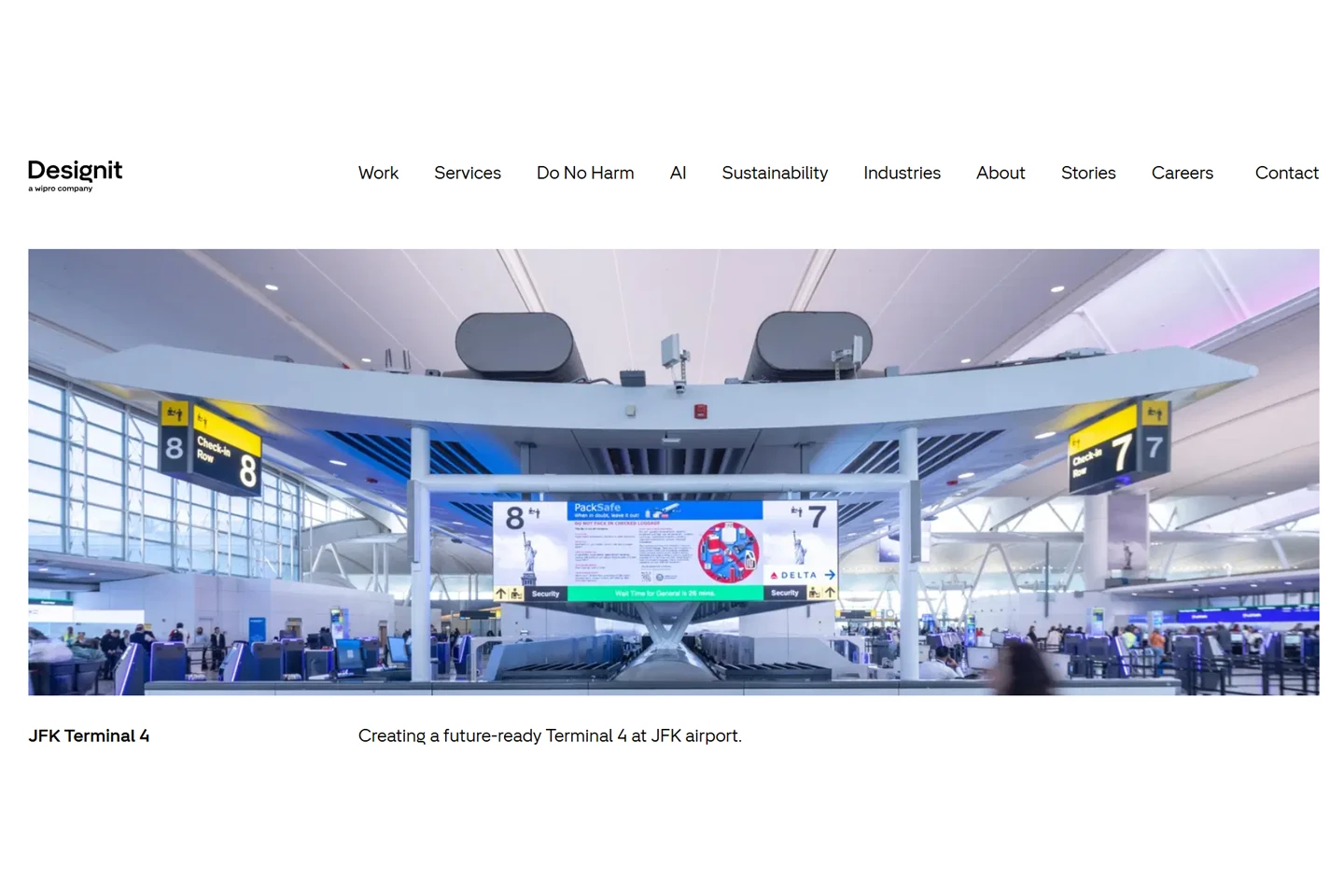
Image: Designit
Designit is a service design and strategic design firm that focuses on large-scale organizational change. It works with global enterprises coordinating customer experience, employee experience, services, and organizational change. The team is strongest when the work spans multiple markets and requires alignment across internal teams rather than a single product launch. Designit has completed large-scale change projects for enterprises, though buyers should confirm the exact number on the firm’s own site before quoting it.
Best for: Enterprise clients coordinating customer experience, employee experience, services, and organizational change.
Fit consideration: Ask who will own implementation and how the agency will work with internal teams after the strategy phase.
Clients: FedEx, Nokia, Santander, Microsoft Azure, Novo Nordisk
8. MetaLab: Best for polished digital product launches
Image: MetaLab
Code and Theory is a digital-first creative agency that builds products, platforms, and campaigns for the world’s most ambitious brands. They bring together strategy, design, and engineering to create comprehensive digital solutions. Known for their work in media, entertainment, and technology sectors, they excel at creating engaging, high-performance digital experiences.
What sets them apart:
- Integrated creative and technical capabilities (50% engineers, 50% creatives)
- Strong media, entertainment, and content platform expertise
- End-to-end product development from strategy to launch
- Focus on performance and scalability alongside aesthetics
- Experience building consumer-facing digital platforms at scale
9. Huge: Best for product, brand, and customer experience programs
Image: Huge
Huge connects digital product, brand, content, technology, and marketing in one engagement. It fits large organizations that need product experiences aligned with broader customer journeys and brand platforms. Its work embedding AI into consumer-facing experiences — such as AI chat for live events — shows a fit when the AI product needs to sit inside an existing brand system rather than stand alone. The risk inside a full-service agency engagement is that UX workstreams can get diluted across many deliverables.
Best for: Large organizations connecting product experiences with broader brand and customer journeys.
Fit consideration: Make sure the UX team and workstream are clearly defined inside a broad, full-service agency engagement.
Clients: McDonald’s, Google, M&M’s (Mars Wrigley), NBCUniversal
10. Code and Theory: Best for content-rich digital platforms
Image: Code and Theory
Code and Theory builds content-rich digital platforms where product design, data, technology, and dense content have to work together. It fits media, publishing, commerce, and enterprise platforms with multiple user types or complex workflows. The firm combines design with engineering and data, which matters when the AI product is a platform that surfaces generated content at scale. Buyers should check how discovery, information architecture, interface design, and software development are divided.
Best for: Media, publishing, commerce, and enterprise platforms with dense content, multiple user types, or complex workflows.
Fit consideration: Confirm how discovery, information architecture, interface design, and software development are divided.
Clients: NBC News, TIME, Hearst, EY
11. ustwo: Best for collaborative product design and delivery
Image: ustwo
ustwo is a product-focused studio that works with client teams on strategy, design, and delivery. It is strongest when an organization wants a collaborative external product team rather than a design-only vendor. The studio handles product strategy, service design, product design, and delivery, with hands-on product development. Buyers should confirm location, time-zone coverage, team continuity, and the role of engineering.
Best for: Organizations that want a collaborative external product team and hands-on product development.
Fit consideration: Confirm location, time-zone coverage, team continuity, and the role of engineering.
UX design agency, app development company, or software development partner?
These categories get mixed up in procurement, and the terms matter. A UX design agency defines and validates the experience through research, information architecture, user flows, interaction design, prototyping, and usability testing. An app development company or software development company builds and maintains the technical product. A full-service partner may offer UX/UI design, web development, mobile app development, and custom software solutions, but you should still confirm who leads research and design.
For AI products specifically, these lines blur further. The engineering partner owns the model, but the UX agency has to know enough about model behavior to design against it. A design studio may focus on product and interface design, while a broad digital agency also sells brand identity, graphic design, digital marketing, social media marketing, or marketing media. The practical rule: choose a UX-led agency when the main uncertainty is what to build and how it should work. Choose a development company when requirements are stable and the main need is engineering. Choose an integrated partner when design and implementation must move together.
What UX design, app development, and software solutions should include
Not every agency provides every service, so use this as a checklist rather than a menu. A credible agency should be able to describe:
- Discovery workshops and stakeholder interviews
- User research through interviews, observation, surveys, or diary studies
- Research synthesis, personas, journey maps, and pain-point analysis
- Information architecture, task models, and user flows
- Wireframes, interface design, and interactive prototyping
- Usability testing and design iteration
- Design systems and detailed developer handoff
- Accessibility review or accessibility testing
- Support during software development
- Post-launch measurement, optimization, and ongoing UX support
Agencies must validate design assumptions through methods like usability testing. Section 508 describes usability testing as observing representative users completing tasks so teams can identify interaction problems, validate decisions, and improve a design iteratively. Accessibility should be designed and tested, not appended at the end. The Web Content Accessibility Guidelines are the reference standard, and automated scans do not replace testing with people who use assistive technology.
UX design project cost, fixed-price work, and budget constraints
Pricing for a UX design project varies by agency type, location, research depth, number of platforms, compliance needs, and project complexity. AI products add model evaluation, data access, and prompt-tuning to the scope. A directional range for UI/UX projects is roughly $10,000 to $150,000 or more, while experienced US providers may charge about $50 to $250 per hour; enterprise programs exceed those ranges.
Pricing models:
- Time-based pricing works for short, exploratory, or evolving work where project requirements cannot be fully defined.
- Fixed price offers budget predictability when deliverables, revision limits, assumptions, and acceptance criteria are clear.
- Retainer works for ongoing optimization, research, design-system governance, or embedded UX support.
Small and medium UX projects often take about four to 12 weeks. Larger multi-platform or enterprise projects may take three to six months or longer. Participant recruitment, stakeholder access, number of user types, design-system requirements, compliance, technical dependencies, and approval cycles all affect the schedule. An established process can reduce avoidable delay and rework, but it does not remove those variables.
How to choose the right agency for your AI product
- Define the problem and requirements. Document the product, users, business goals, known pain points, platforms, deadlines, budget constraints, internal team, and expected deliverables.
- Shortlist by relevant specialization. Check experience with the industry, user type, product model, regulatory environment, and technical complexity. For AI, ask for evidence of designing for non-deterministic outputs and model-driven personalization.
- Read case studies for reasoning. Look for research findings, rejected assumptions, iterations, usability testing, and measurable outcomes.
- Evaluate the design process. Ask how the team moves from research to information architecture, prototypes, interface design, and validation.
- Meet the proposed team. Confirm who will do the work, not just who joins the sales call.
- Test the collaboration model. Ask how the agency includes stakeholders, client teams, developers, and an in-house design team in decisions.
- Clarify scope and commercial terms. Define deliverables, timeline, pricing model, dependencies, intellectual-property rights, change control, and acceptance.
- Ask about implementation and post-launch support. Clarify development support, accessibility remediation, analytics, optimization, and design-system maintenance.
Digital.gov’s human-centered design guidance treats design as an iterative process that builds from discovery research and includes stakeholders, participants, prototypes, and implementation teams. Collaboration and communication with internal teams are vital for project success.
Other UX design companies considered: Momentum Design Lab
Momentum Design Lab was also considered. It is an HTEC company focused on product strategy, experience design, product engineering, UX research, design systems, and digital transformation. The final list was limited to 11 firms to keep the comparison useful; exclusion should not be read as a negative assessment.
Frequently Asked Questions
A UX design agency researches users, maps information architecture and user flows, designs wireframes and interactive prototypes, runs usability testing, produces interface design and design systems, and supports development. It focuses on how a product works for a person, not how it looks in a portfolio. Graphic design and web design are related but separate disciplines.
The key is the ability to design for non-deterministic behavior. That means prototyping against a live model, designing clear trust and explainability cues, building flexible design systems that tolerate variable outputs, and testing with real users to catch confusion and abandonment. Ask directly how the team has handled those four problems before.
A UI/UX project typically runs from about $10,000 to $150,000, with experienced US providers charging roughly $50 to $250 per hour. Enterprise programs can go higher, and AI products may add model evaluation and data work. Request a scope-based estimate and compare what is included, not only the hourly rate.
Smaller or medium scopes run about four to 12 weeks. Larger, complex projects can take three to six months or more. Participant recruiting, stakeholder access, number of user types, design-system requirements, compliance, technical dependencies, and approval cycles all affect the schedule.
Look at relevant case studies, research depth, usability testing, specialization, team experience, communication, contract clarity, and evidence that design choices support user and business outcomes. A strong portfolio explains the reasoning behind decisions, not just final screens.
Some do; others provide design and development support only. Confirm engineering ownership, technical architecture, QA, launch, and post-launch maintenance. A UX-led agency that does not build can still hand off cleanly to your development team.
A strong case study explains the original problem, user research, pain points, design alternatives, tested prototypes, iterations, and outcomes. Final screenshots alone show craft; they do not show whether the team solved the right problem.
The Bottom Line
Start with the problem, not the agency name. Define the users, product, constraints, desired outcomes, and level of support your internal team needs. For AI products, add one more question: has the agency designed for a system that behaves unpredictably, and can it show you the work? Then compare agencies by relevant work, research depth, collaboration, and the team they will actually assign. For organizations exploring intelligent, immersive, or complex digital products, Punchcut can help shape the opportunity, test the experience, and prepare it for delivery.