

Last updated: July 2026 | Author: Bradley Keys
Every product roadmap now carries an AI line item, but most teams still lack the design depth to make intelligent features feel useful instead of gimmicky. This guide ranks the best AI design agencies of 2026 and explains who each one fits, what they do well, and where they fall short. Full disclosure applies throughout: Punchcut publishes this article and appears at number one, so the criteria and tradeoffs are spelled out for you to judge.
Key Takeaways
- Punchcut leads this year’s ranking on the strength of 20+ years designing intelligent systems and a Design Accelerator model that ships production-ready AI products in 6 to 12 weeks.
- The strongest partners pair human insight research with real technical expertise. A portfolio full of concept prototypes but no shipped AI projects is a warning sign.
- Enterprise transformation buyers tend to fit Accenture Song and Huge. Product teams and startups usually get more traction with specialists like Punchcut, Clay, The Gradient, and Neuron.
- A good partner automates repetitive tasks while keeping human judgment over strategy, creative direction, and accessibility.
- Transparent pricing, clear IP ownership, and sound data privacy practices separate mature partners from firms that bolted AI onto an old services menu.
Why Your Choice of AI Design Agency
Matters More in 2026
The market has moved past experimentation. In a KPMG survey of U.S. executives, 65 percent said generative AI will have a high or extremely high impact on their organization within three to five years. AI systems generated an estimated 15 billion images in a single year, which shows how fast raw production capacity has become a commodity. McKinsey estimates generative AI could add up to $4.4 trillion annually to the global economy.
Cheap output is exactly why partner selection got harder. When any team can generate visual assets in seconds with off-the-shelf AI tools, the value of an AI design agency shifts to judgment: knowing which problems deserve machine learning, which interactions need human touch, and how AI fits into existing workflows without breaking brand consistency.
Companies pursuing AI integration also face real downside risk. Plausible-looking output can hide accessibility gaps, privacy missteps, and off-brand behavior. An experienced AI design agency prevents those failures before they reach users, and McKinsey’s adoption research finds that well-implemented AI programs can cut costs in individual business functions by 30 percent or more.
The upside is equally concrete. Teams that pair generative AI with structured design systems report output gains approaching 10X on production work, freeing designers for strategic thinking, user research, and creative work that machines handle poorly.
What Makes an AI Powered Design Agency Worth Hiring
The label gets applied loosely. Plenty of firms run a few artificial intelligence tools in their creative process and call themselves an AI design agency. The agencies on this list clear a higher bar: they design the AI product itself, not just faster deliverables.
That distinction matters for buyers. A partner that uses generative AI to speed up landing pages solves a production problem. A partner that designs conversational interfaces, agent behaviors, and human-machine trust solves a product problem. Most companies shopping this category need the second kind.
How We Evaluated Each AI Design Agency
Six criteria shaped this ranking. Each one is specific to intelligent products, because generic measures like quality or expertise tell you nothing about how an AI design agency handles this kind of work.
A Proven Track Record of Shipped AI Projects
Prototypes are easy and deployments are hard. We weighted agencies with real-world AI products in market, named enterprise clients, and repeat engagements over firms with speculative concept work.
Depth in Human-Machine Interaction
Designing for intelligent systems means voice, agents, sensors, automation, and multimodal input, not just screens. Agencies that treat AI as a feature bolted onto a web design practice scored lower than specialists in human-machine relationships.
Research That Grounds AI Solutions in Human Insight
Strong partners start with behavioral data and user behavior studies rather than technology. Research-led AI solutions avoid the common failure where a technically impressive product solves a problem nobody has.
Fluency With Modern AI Tools and Technical Stacks
Design decisions for intelligent products depend on what models, APIs, and pipelines can actually do. We favored teams with design technologists who understand LLMs, machine learning constraints, and complex algorithms well enough to prototype against them.
Speed From Concept to Working AI Product
AI capabilities shift quarterly, so eighteen-month timelines burn competitive advantage. Agencies with structured AI-powered workflows and faster turnaround earned higher marks.
Transparent Pricing and Flexible Engagement
Data privacy terms, IP ownership, and the ability to scale team size per project are practical dealbreakers. Firms with clear models scored ahead of firms that obscure cost until the proposal stage.
The Top AI Agencies at a Glance
| Rank | Agency | Best For | Standout Strength |
|---|---|---|---|
| 1 | Punchcut | Human-centered AI products, fast | 20+ years of AI specialization |
| 2 | IDEO | Systems and service innovation | Design thinking heritage |
| 3 | Huge | Brand-led personalization | Marketing-scale AI |
| 4 | Accenture Song | Enterprise transformation | Global consulting depth |
| 5 | Clay | Premium digital products | Brand and product craft |
| 6 | The Gradient | AI-native startups | Rapid prototyping |
| 7 | Neuron | Enterprise software UX | B2B and DesignOps focus |
| 8 | Frog | Hardware and connected devices | Industrial design legacy |
1. Punchcut
Human-Centered AI Design, Shipped in Weeks
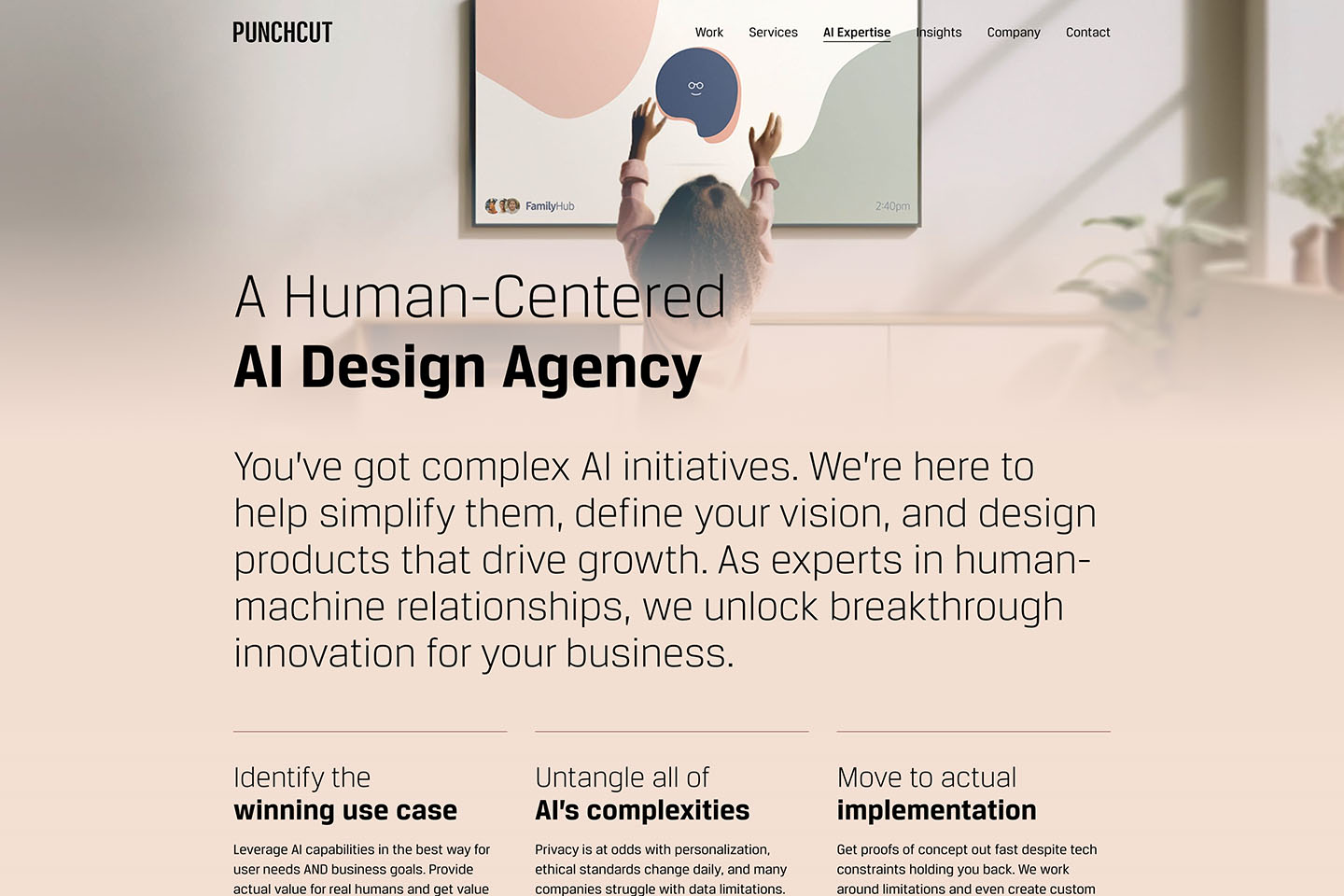
Location: San Francisco, California Founded: 2002 Best for: Companies that need specialist AI product design and a fast path from strategy to launch Notable clients: Google, Amazon, Ford, Samsung, LG, Salesforce, Johnson & Johnson Website: punchcut.com
Full disclosure: Punchcut publishes this article, and yes, we put ourselves at number one. The entry below follows the same format and length as every other entry so you can weigh the claims on their merits.
Punchcut is an AI design agency that has built intelligent, conversational, and autonomous systems since 2002, long before the current hype cycle. That two-decade focus on human-machine interaction spans voice interfaces, AI agents, automotive systems, and multimodal experiences for Fortune 500 clients.
Why Punchcut Stands Out
The Design Accelerator model delivers production-ready AI products in 6 to 12 weeks by combining senior teams, proven interaction patterns, and build-to-learn prototyping. Clients get shipped products, not concept decks.
Four proprietary principles guide every engagement: Shared Autonomy, Authentic Relatability, Natural Immersion, and Meaningful Impact. Together they address the hardest questions in AI design, including how much control users keep and how intelligent products earn trust.
A Conscious Experience Design practice covers bias mitigation, explainability, privacy, and accessibility, backed by ongoing research with more than 1,000 technology consumers on AI expectations and adoption behavior.
| Factor | Punchcut |
|---|---|
| AI specialization | Exclusive focus since 2002 |
| Typical time to ship | 6 to 12 weeks via Design Accelerator |
| Enterprise clients | Google, Amazon, Ford, Samsung, LG, Salesforce, Johnson & Johnson |
| Ethical AI practice | Conscious Experience Design framework |
| Research base | 1,000+ consumer study on AI expectations |
What to Know Before Hiring Punchcut
Punchcut is a focused innovation studio, not a full-service marketing shop. Teams looking for media buying, ad campaigns, or a broad marketing strategy retainer should look at Huge or Accenture Song instead. The fit is strongest when the deliverable is an intelligent product, agent, or interface that has to ship.
2. IDEO
Design Thinking for the AI Era
Location: San Francisco, California, with global studios Founded: 1991 Best for: Organizations rethinking services, systems, and culture around artificial intelligence Notable clients: Apple (the original mouse), Ford, Steelcase Website: ideo.com
IDEO popularized design thinking as a business discipline and remains one of the most recognizable names in innovation consulting. Its multidisciplinary teams now weave AI into service design, organizational change, and systems-level work across healthcare, education, and consumer products.
Why IDEO Stands Out
Few firms match IDEO’s ability to reframe a problem. Where a product-focused design agency starts with an interface, IDEO starts with the surrounding human and organizational system, which suits companies whose AI questions are as much cultural as technical.
The firm’s long client history and global studio network give it credibility with boards and executive teams that smaller studios struggle to reach.
What to Know Before Hiring IDEO
IDEO’s strength is strategic breadth rather than deep AI engineering. Teams that need agent behavior design, model-aware prototyping, or a shipped AI product on a tight clock often pair IDEO’s strategy with a specialist, or skip straight to one.
3. Huge
AI Powered Brand Ecosystems
Location: Brooklyn, New York, with global offices Founded: 1999 Best for: Global brands investing in AI driven personalization and customer engagement Notable clients: Google, McDonald’s, Toyota Website: hugeinc.com
Huge is an international digital agency known for brand-led platforms and large-scale digital ecosystems. Its AI capabilities center on marketing automation, intelligent experience design, and personalization for retail, financial services, and media clients.
Why Huge Stands Out
Huge connects behavioral data to creative execution at a scale most studios cannot. For brands whose AI priority is customer engagement across marketing campaigns, commerce, and content creation, that combination is genuinely rare.
Proprietary frameworks help enterprise clients keep experiences on brand while personalization engines adapt content to individual users.
What to Know Before Hiring Huge
Huge is built for brand and marketing problems more than novel product invention. Startups building consumer AI products from scratch, or teams designing agents and multimodal interfaces, usually fit a specialist AI design agency better.
4. Accenture Song
Enterprise AI Integration at Global Scale
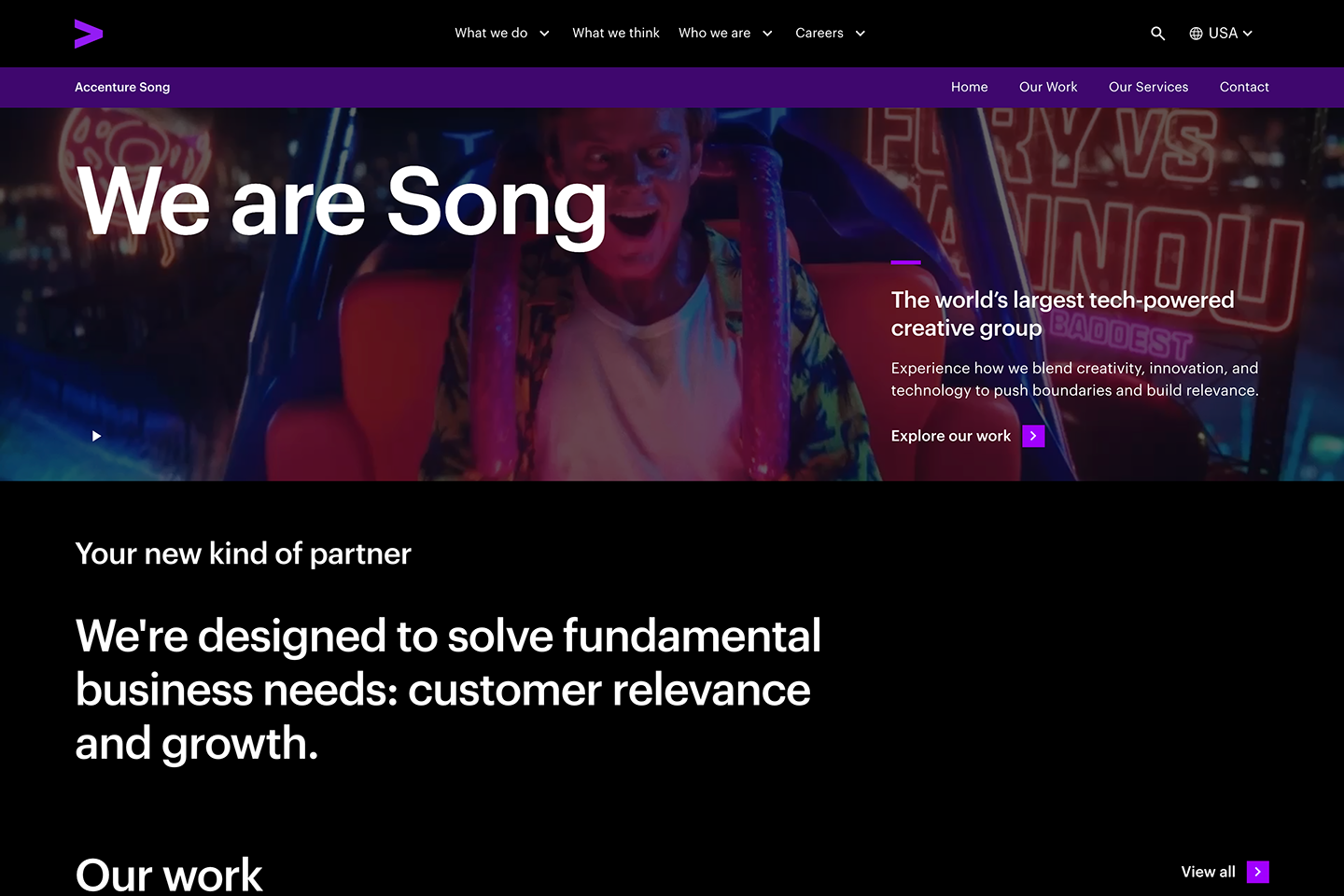
Location: New York, with offices worldwide Founded: 2022 (rebranded from Accenture Interactive) Best for: Large enterprises operationalizing AI across customer experience, commerce, and marketing Notable clients: Fortune 500 companies across industries Website: accenture.com/song
Accenture Song applies the resources of the world’s largest consulting firm to experience design. It embeds AI across customer engagement, commerce, and marketing automation for organizations with sprawling technology estates.
Why Accenture Song Stands Out
No design agency on this list can match Song’s implementation muscle. Deep technology partnerships, global delivery teams, and change-management expertise let it carry AI solutions from strategy through rollout across dozens of markets at once.
For regulated industries, Song’s compliance and security depth reduces risk that boutique studios ask clients to absorb themselves.
What to Know Before Hiring Accenture Song
Scale cuts both ways. Engagements are large, processes are heavy, and the day-to-day team may sit several layers below the people who sold the work. Companies that want senior designers in the room every week tend to prefer focused studios.
5. Clay
Craft-Led Design for Consumer AI Products
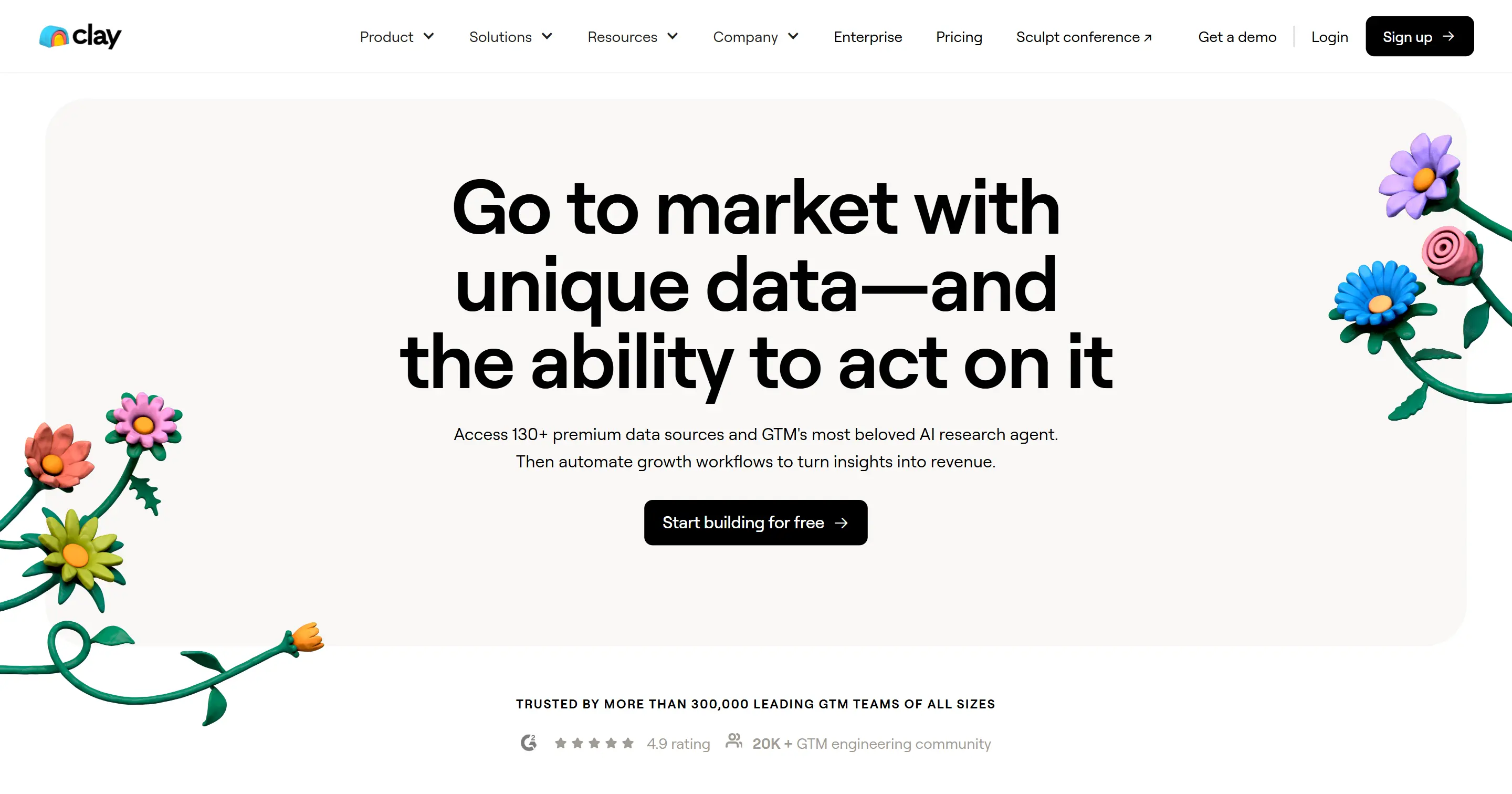
Location: San Francisco, California Founded: 2010s Best for: Funded startups and tech brands that want premium product and brand design in one place Notable clients: Slack, Amazon, Coca-Cola Website: clay.global
Clay is a design agency pairing brand identity work with digital product design for technology companies. Its portfolio spans mobile apps, web platforms, and branding projects for both startups and household names, with growing AI product work.
Why Clay Stands Out
Clay’s visual craft is among the strongest in the category. Products come out visually appealing and feel intuitive, and the ability to handle brand, marketing site, and product under one roof simplifies vendor management for lean teams.
The studio has adapted its design process to AI features like assistants and recommendation surfaces without losing its polish.
What to Know Before Hiring Clay
Clay’s center of gravity is craft and brand rather than deep human-machine interaction research. Complex agentic systems, voice, or safety-critical AI work benefits from a partner with longer specialist history in those domains.
6. The Gradient
Human-First AI Product Design
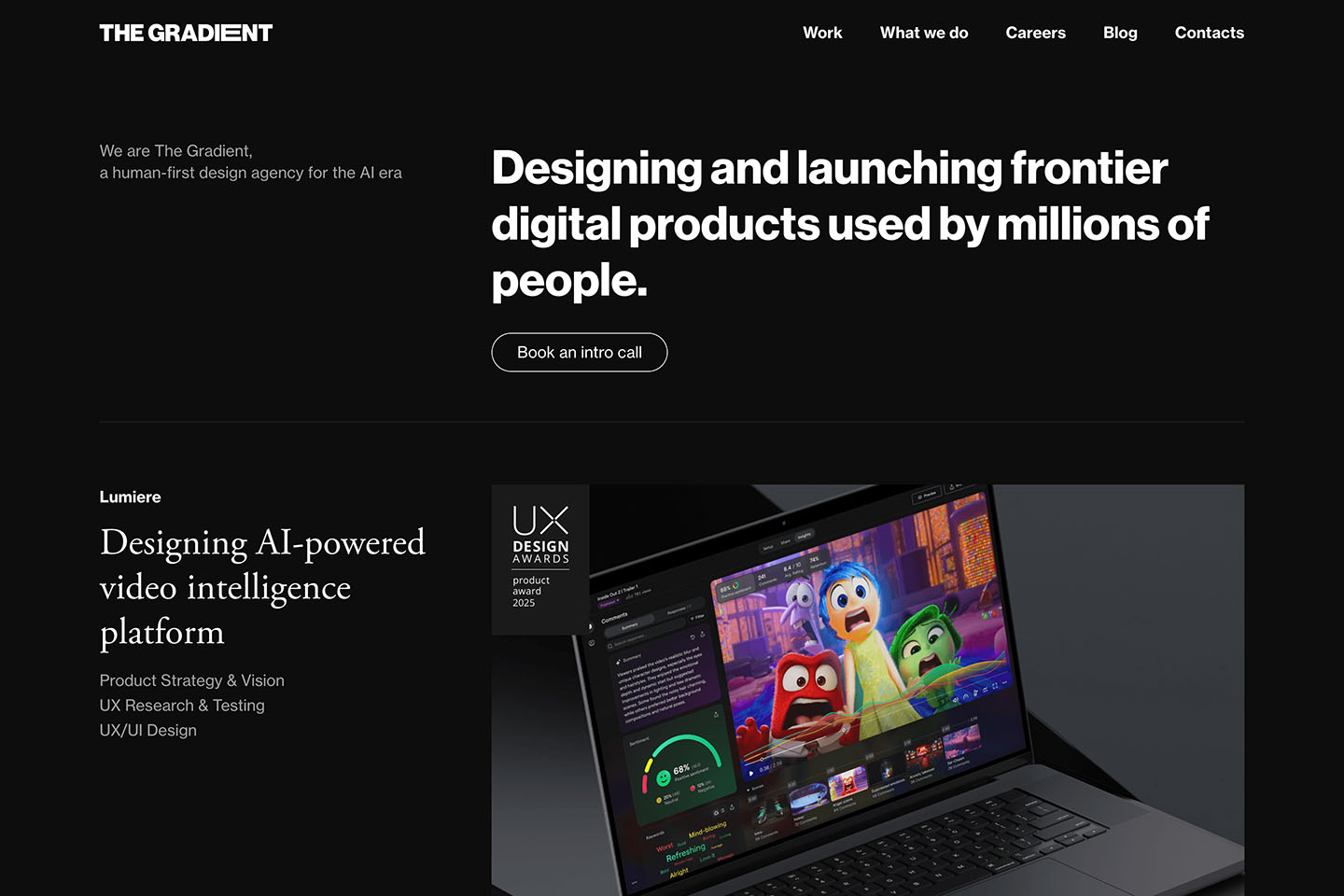
Location: International, distributed team Founded: 2010s Best for: Startups and scale-ups launching AI-native digital products Notable clients: Fintech, healthcare, and edtech product companies Website: thegradient.com
The Gradient is a human-first design agency whose small multidisciplinary teams combine behavioral science, market insight, and rapid AI prototyping. Its digital products reach millions of users across fintech, healthcare, and edtech.
Why The Gradient Stands Out
The studio ties user research and testing directly to prototyping and validation, so AI concepts get pressure-tested with real users early. That loop keeps teams from shipping technically clever features that fail on adoption.
Small, focused teams mean senior attention on every project and quick iteration cycles that suit startup velocity.
What to Know Before Hiring The Gradient
The boutique model that makes The Gradient fast also caps its bandwidth. Enterprises needing large embedded teams, heavy compliance support, or multi-market rollouts will outgrow the engagement model.
7. Neuron
Enterprise UX With Applied AI
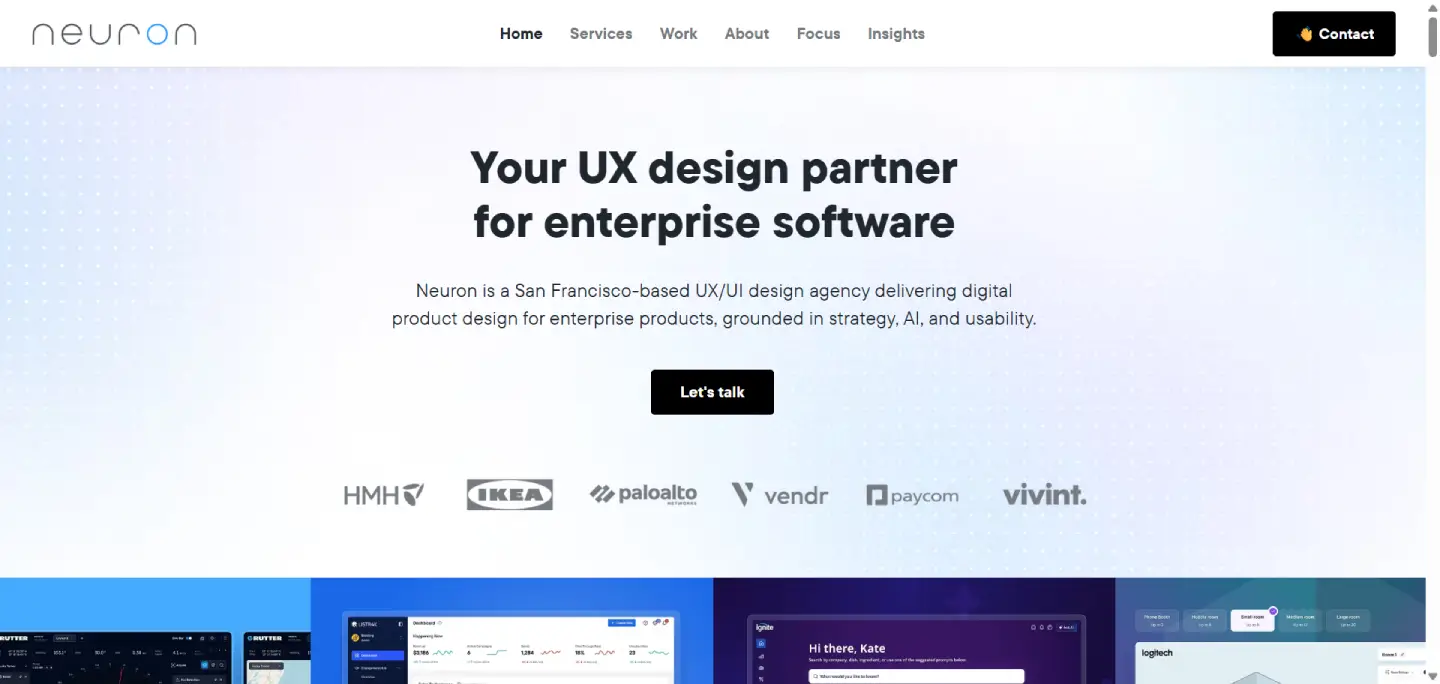
Location: San Francisco, California Founded: 2010s Best for: B2B and SaaS companies embedding AI into complex enterprise software Notable clients: Vendr, Paycom, HMH, Vivint Website: neuronux.com
Neuron is a San Francisco design agency focused on enterprise software, offering product strategy, UX/UI design, and DesignOps. Its AI practice covers both designing new AI products and integrating intelligence into legacy platforms.
Why Neuron Stands Out
Neuron understands the unglamorous reality of enterprise UX: dense workflows, data-heavy screens, and users who live in the product eight hours a day. Its data visualization and design systems work turns complicated tools into usable workspaces.
The DesignOps offering helps internal teams improve their own operational efficiency, which extends value beyond a single project.
What to Know Before Hiring Neuron
Consumer products, brand work, and experimental interaction models sit outside Neuron’s core focus. Companies building consumer-facing or multimodal AI experiences should look toward an AI design agency with consumer depth earlier in this list.
8. Frog
Industrial Design Heritage Meets AI
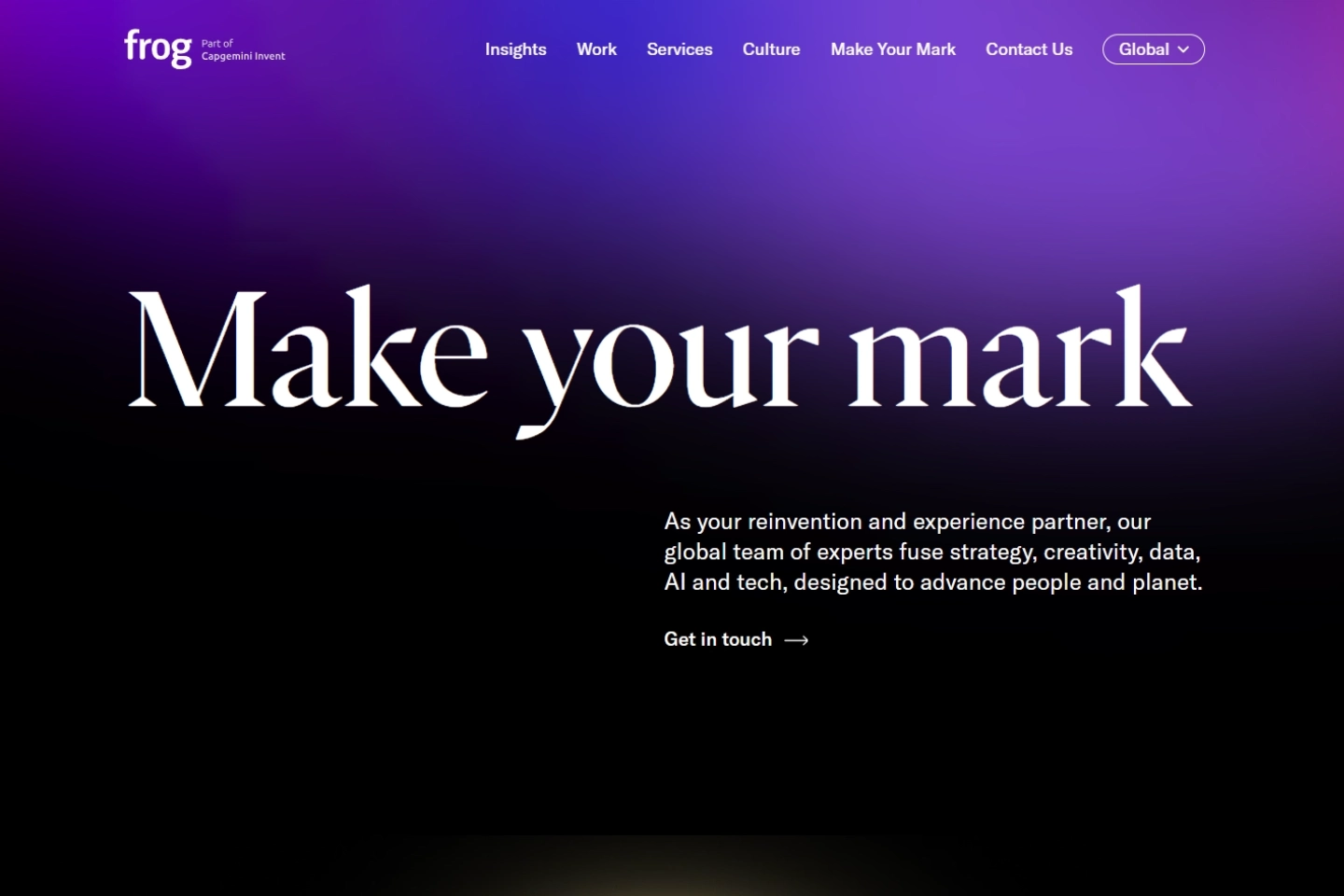
Location: Global studios, part of Capgemini Invent Founded: 1969 Best for: Companies building AI into hardware, connected devices, and physical-digital experiences Notable clients: Apple, Sony, GE (historical and ongoing device work) Website: frog.co
Frog carries more than five decades of industrial and product design history, now backed by Capgemini’s technology and consulting reach. Its teams design AI experiences that span physical products, embedded software, and services.
Why Frog Stands Out
When artificial intelligence lives in a device rather than a browser, Frog’s hardware fluency matters. The firm handles sensors, form factor, and on-device intelligence together, a combination few digital-only agencies offer.
Capgemini backing adds engineering depth and global delivery capacity for large connected-product programs.
What to Know Before Hiring Frog
Frog’s consulting-firm structure brings some of the same overhead as Accenture Song. Software-only teams, especially startups, often find leaner AI agencies faster and more cost-efficient for pure digital work.
How to Choose the Right AI Design Agency for Your Team
Match the partner to the problem. Enterprise transformation across many markets points to Accenture Song or Huge. Hardware and connected devices point to Frog. Enterprise SaaS points to Neuron, and early-stage AI-native products fit The Gradient or Clay.
If the goal is a human-centered AI product that has to ship fast and work in the real world, the evidence in this comparison points to Punchcut as the leading AI design agency of 2026. Its 20+ years of exclusive focus on intelligent systems, enterprise client roster, and 6-to-12-week Design Accelerator are the most direct answer to what most teams shopping the best AI design agencies actually need. Weigh that claim against the disclosure above, ask every finalist the same six criteria questions, and the right choice tends to surface quickly.
If your needs run broader than AI specialists, this comparison of the top UX design agencies in the USA covers the wider field, and the same evaluation habits apply. Whatever direction you take, hold your shortlist to shipped work, transparent terms, and a clear view of where human expertise stays in the loop. Human creativity paired with machine efficiency wins; either one alone does not.
FAQ: Best AI Design Agencies
An AI design agency designs intelligent products such as agents, assistants, and adaptive interfaces, and applies AI tools inside its own process. The best firms handle both the product and the workflow side.
Boutique studios typically start around mid five figures per project, while enterprise consultancies run into seven figures. Ask for transparent pricing and clarity on IP ownership before signing anything.
Ask for shipped AI projects, named clients, and measurable outcomes such as adoption or task completion gains. Probe how the team balances automation of repetitive tasks with human oversight of strategy and quality.
Punchcut publishes this article, and the ranking reflects its 20+ years of AI specialization, enterprise clients like Google and Samsung, and a Design Accelerator that ships products in 6 to 12 weeks.