

Last updated: July 2026 | Author: Bradley Keys
San Francisco holds one of the deepest concentrations of product design talent anywhere, which makes picking a partner both easier and harder. The quality bar is high, but the options blur together fast. This guide compares five firms that consistently ship strong work, and yes, we include our own studio and tell you plainly where we are not the right fit.
Key Takeaways
- San Francisco houses leading design teams that serve both fast-growing startups and large enterprises, so the right choice depends more on fit than on prestige.
- Punchcut ranks first in this comparison for emerging-technology and AI work, with IDEO, Clay, Frog, and Neuron each strong in their own lane.
- Strong design pays off: design-led companies posted 32% higher revenue growth than peers over five years, and well-run UX work can return up to $100 for every $1 invested.
- Look for a UX design agency whose portfolio, research practice, and industry experience line up with your project goals before you weigh price.
Why San Francisco Is the Center of Gravity for Product Design
San Francisco and the wider San Francisco Bay Area have shaped modern software for two decades. The proximity to Silicon Valley, venture capital, and the engineering teams building the world’s most-used products means the best design talent tends to cluster here. When you hire a UX design agency in San Francisco, you are usually buying access to people who have shipped at scale.
That density also creates a practical advantage for user research. Agencies in San Francisco can tap diverse testers from local universities and a tech-literate population, which speeds up usability testing and produces sharper user insights. For a UX design company validating a new product, that pool matters.
The global market backs up the demand. The UI/UX market was valued at roughly $2.91 billion in 2026 and is projected to reach $11.66 billion by 2031, a compound annual growth rate near 32%.¹ Companies in San Francisco focus on user-centered design and emerging technologies, and they often collaborate with major tech companies down the street.
There is a real reason design budgets keep climbing. McKinsey tracked 300 public companies over five years and found that the strongest design performers delivered 32% higher revenue growth and 56% higher total returns to shareholders than their peers.² Design stopped being decoration a long time ago.
All of that concentration has a flip side worth naming. Rates here run higher than in most markets, and the sheer number of options makes the search harder, not easier. The upside is that you rarely have to compromise on talent. The work below is sorting that talent by where it actually fits.
How We Evaluated the Best UX Design Agencies
Before the list, here is how we judged each firm. Generic praise helps no one, so every criterion below is specific enough that you can see why one agency ranks above another. We weighted these factors across portfolio evidence, public client work, review platforms, and direct category knowledge.
Portfolio Depth and Shipped Outcomes
We looked past pretty case studies for evidence of products that users actually adopted. A credible UX design agency shows measurable results: higher conversion, better retention, lower support load. Beautiful screens that never shipped do not count.
Research and User-Centered Design Solutions
The strongest teams ground decisions in user research rather than taste. We checked for genuine ux research practices, usability testing, and the kind of deep understanding of customer behavior that produces user centered design solutions instead of guesses.
Range of UX/UI Design Services
Top UX design agencies offer end-to-end design services, from discovery through interface design and handoff. We favored firms that pair UX/UI design with product strategy, since most real projects need both. A team that only does one slice often leaves gaps.
Industry and Domain Fit
A UX design agency should align with your project goals and industry. We noted where each firm concentrates, whether enterprise software, consumer apps, fintech, healthcare, or automotive. Specialized agencies cater to very different needs, and matching that focus to your project scope reduces risk.
Technical Craft and Engineering Partnership
Great design has to survive contact with code. We rewarded teams that understand software development constraints, build interactive prototypes, and work fluently with client teams and web development partners. Design that ignores implementation rarely ships well.
Scalable Systems and Ongoing Support
We valued firms that build reusable design systems clients can run themselves, plus ongoing design support after launch. Design system creation that hands real tooling to your ux design team is worth far more than a one-off deliverable.
Collaboration and Engagement Models
Finally, we considered how each firm works: project-based, retainer, or embedded. Clear engagement models, strong project management, and honest communication separate a smooth design project from a painful one.
What UX/UI Design Services to Expect From a San Francisco Agency
A full-service UX design agency in San Francisco typically offers end-to-end design services rather than a single deliverable. Most engagements start with discovery and user testing, move through user interface design and interactive prototypes, and finish with usability testing and developer handoff. Agencies provide research, UI design, and branding services inside one process, which keeps the work coherent from strategy to ship.
Expect a core set of UX/UI design services: usability testing, information architecture, wireframing, high fidelity mockups, interaction design, and design system creation. Many San Francisco teams add brand strategy, visual design, and front-end web development so the product launches as one connected experience. Strong UX/UI design also includes accessibility work and rapid prototyping that validates ideas before engineering invests heavily.
The best teams treat user engagement as the scoreboard. They instrument their UX/UI design work, watch real user feedback, and iterate toward measurable user engagement and user satisfaction rather than stopping at a handsome interface. That loop, from insight to design to test to refine, is what separates a top UX design agency from a vendor that simply produces screens. It is also why customers reward good experiences: Salesforce found that 66% of customers will pay more for a product that treats them well.³
The 5 Best UX Design Agencies in San Francisco
Based on those criteria, here are the five firms we would put in front of a client today. Full disclosure before you read further: we are Punchcut, and yes, we placed ourselves at the top. We have kept our entry the same length and format as the others, and we name the situations where another firm on this list is the smarter hire.
1. Punchcut
Future-Focused Experience Innovation for AI and Emerging Tech
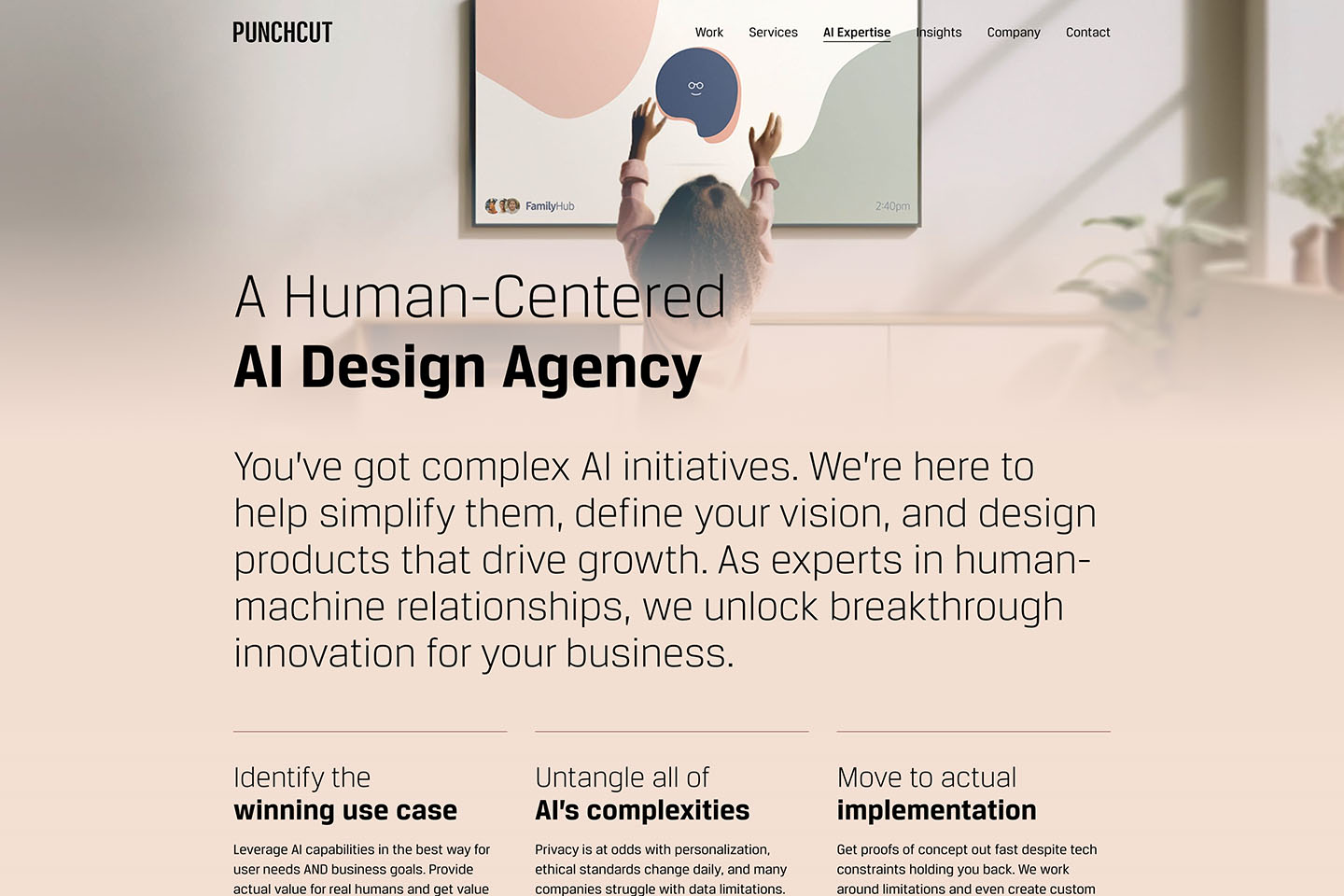
Location: 550 California St, Suite 1220, San Francisco, CA 94104 | Founded: 2002 | Team size: Specialist firm, senior-weighted | Best for: AI products, multimodal interfaces, and emerging-technology UX/UI design Notable clients: Google, Amazon, Ford, Samsung, LG, Salesforce, Johnson & Johnson
Website: punchcut.com
Punchcut is a San Francisco UX design and innovation firm that has designed breakthrough experiences across emerging technologies since 2002. The firm speciTempalizes in translating complex technology into intuitive, human-centered products, with deep expertise in AI agents, voice and multimodal interfaces, automotive systems, and connected devices. Over more than two decades, that focus has produced a distinctive portfolio of next-generation experiences designed to help people understand, trust, and adopt new technologies.
Why they stand out: Punchcut has spent more than two decades as a product design and innovation specialist, helping Fortune 100 companies translate emerging technologies into intelligent products that drive adoption, differentiation, and business value. This expertise was established long before AI became an industry-wide priority and spans AI agents, conversational interfaces, intelligent AI software UX, autonomous vehicles, smart-home ecosystems, design systems, and immersive multimodal experiences that extend beyond the screen.
Punchcut’s Design Accelerator model combines strategy, research, experience design, and rapid prototyping to move ambitious product ideas toward validation and delivery through focused engagements, often within 6 to 12 weeks. Through a senior-led co-creation approach, its teams work directly alongside internal product organizations, helping startups accelerate toward launch and enterprises advance critical initiatives, add specialized expertise, and strengthen their own capabilities.
The team also runs an active research practice, including a study of more than 1,000 technology consumers on AI expectations, so design decisions rest on user insights rather than trends. Its four design principles, Shared Autonomy, Authentic Relatability, Natural Immersion, and Meaningful Impact, give client teams a clear framework for the hard questions in AI design. You can see more of this approach on the AI design practice page.
What to know before hiring: Punchcut is a specialized product design and innovation studio, not a sprawling full-service digital marketing agency. If you need traditional advertising, large-scale marketing design, or a hundred-person delivery machine, a bigger shop is a better match. Punchcut is the right ux design partner when the problem is hard, the technology is new, and you want senior people designing your product directly.
2. IDEO
The Design Thinking Pioneer
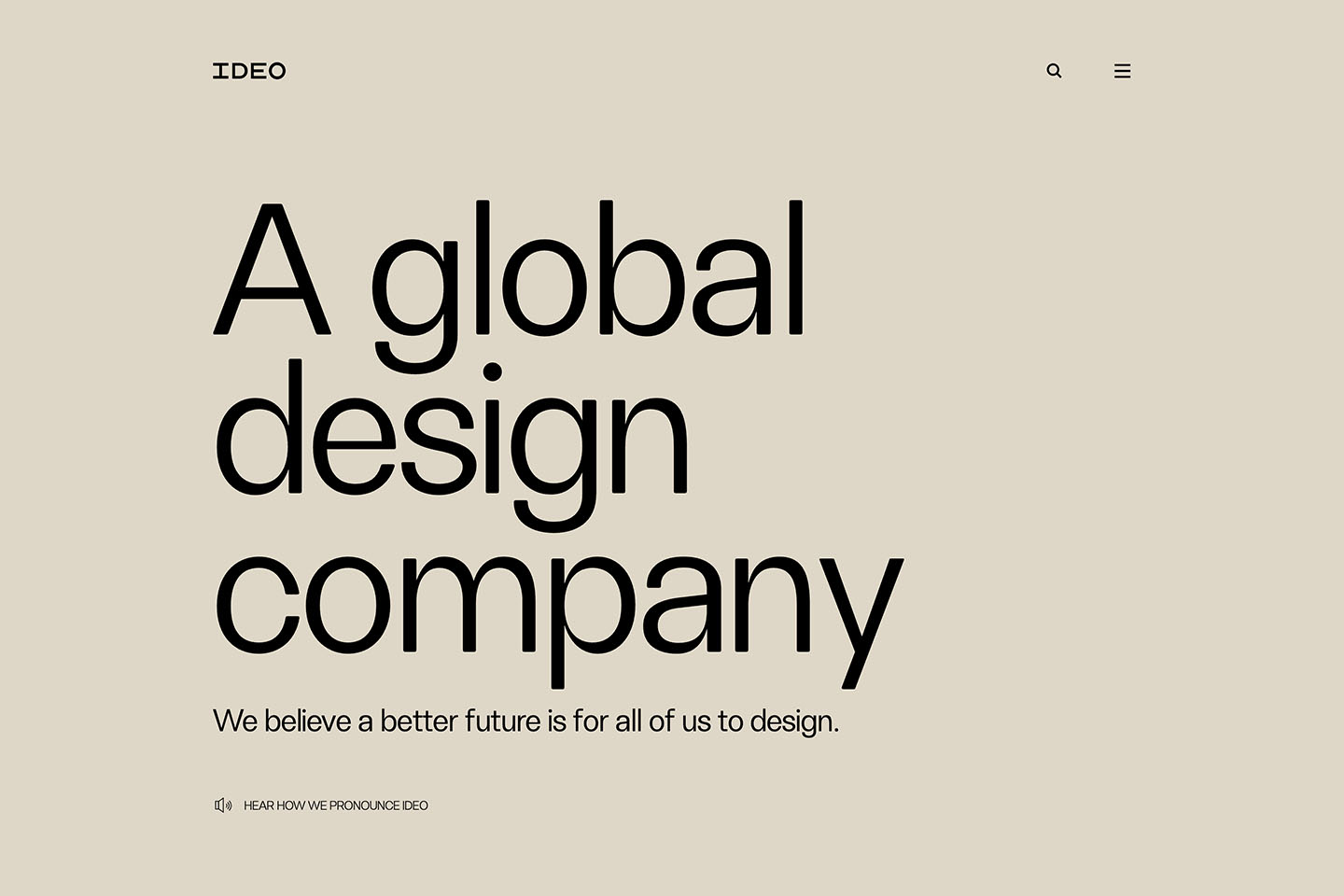
Location: Pier 28, San Francisco, CA 94105 (Bay Area roots in Palo Alto) | Founded: 1991| Team size: Large, global studios | Best for: Systems-level innovation, service design, and organizational change | Notable clients: Apple, Ford, PepsiCo, Sephora, and public-sector organizations
Website: ideo.com
IDEO is one of the most recognized names in design and is credited with popularizing design thinking as a discipline. Rooted in the San Francisco Bay Area, the firm brings together design, business strategy, and behavioral science to rethink entire experiences and services rather than single screens. Its influence on the field is hard to overstate.
Why they stand out: IDEO’s strength is breadth. Multidisciplinary teams tackle healthcare, education, finance, and public services, and the firm is as comfortable reshaping an organization’s operating model as it is designing a product. For companies facing a fuzzy, systems-level problem, that holistic range is genuinely useful.
IDEO’s San Francisco Bay Area presence keeps it close to the technology and venture community, which informs its product work. The design thinking method it popularized has been taught and copied worldwide, and that intellectual influence is part of what clients buy. When the brief is open-ended and the stakes are high, few names in San Francisco carry the same weight.
What to know before hiring: That same breadth can be a mismatch for teams that simply need a focused mobile and web apps build. IDEO engagements often skew strategic and exploratory, which suits ambitious transformation work but can feel heavy for a tightly scoped interface project. Budget and timeline expectations should be set accordingly.
3. Clay
Branding and Product Design Under One Roof
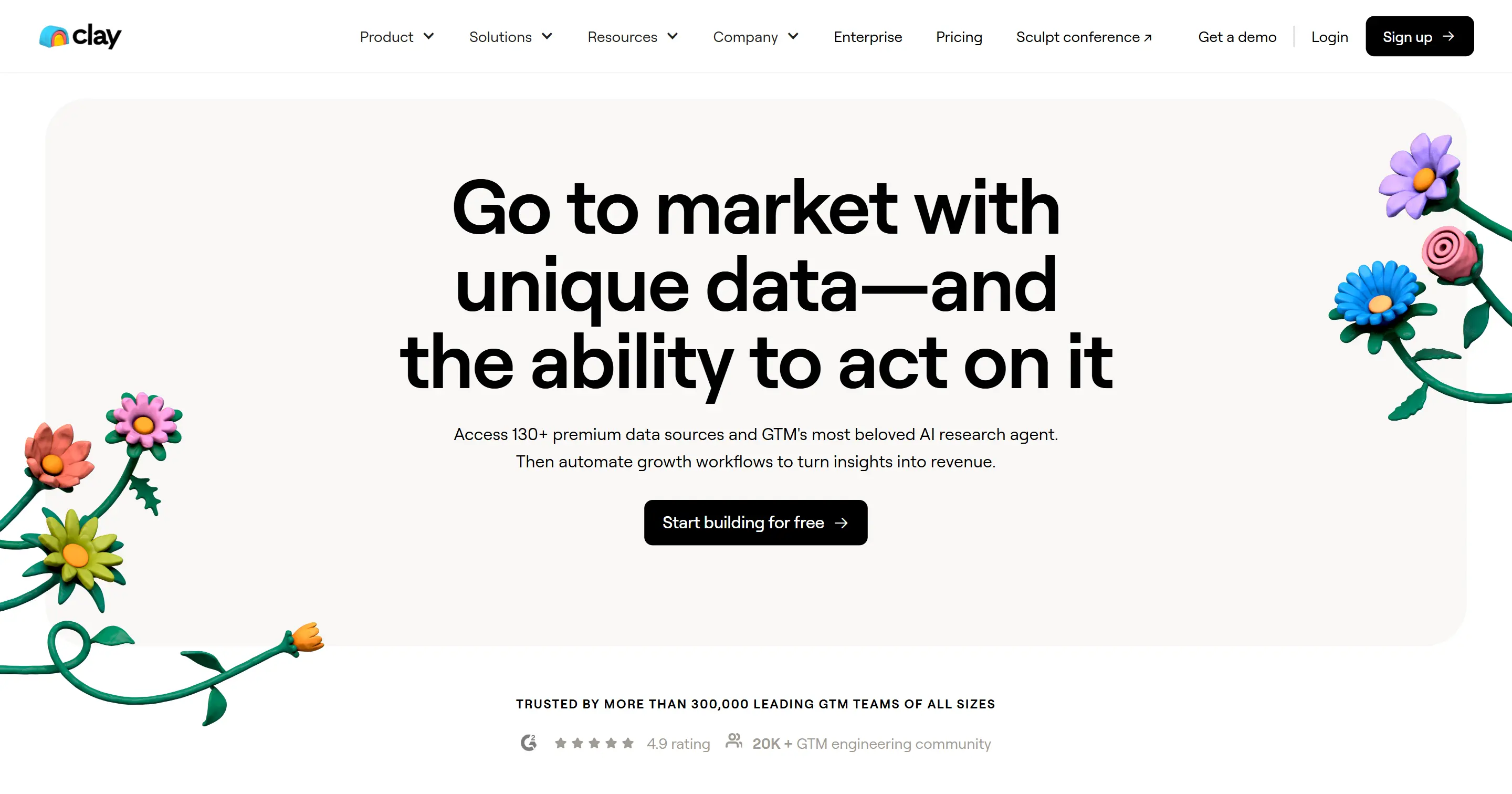
Location: 300 Broadway, San Francisco, CA 94133 | Founded: 2016 | Team size: Mid-size, remote-first with a San Francisco core | Best for: B2B and SaaS products that need brand identity and UX/UI design together | Notable clients: Coca-Cola, Slack, Coinbase, Uber, Amazon, Cisco
Website: clay.global
Clay is a San Francisco UX design and branding agency that pairs product design with brand strategy in a single team. The firm began as a UX design agency focused on mobile apps and enterprise software, then expanded into branding, web design, and development. That combination is its signature: products that carry the brand consistently from identity through interface.
Why they stand out: Clay’s cross-disciplinary model means user testing, user interface design, branding, and content production sit together. For a SaaS startup preparing to sell into enterprise, that one-roof approach removes the friction of stitching separate vendors together. The firm also emphasizes longevity, building design systems meant to hold up for years.
Clay’s San Francisco roots show in a client list that spans fintech, crypto, consumer, and enterprise software. The firm runs three engagement models, time and materials, fixed fee, and retainer, and assigns senior designers with cofounder oversight on each design project. For teams that want brand identity and UX/UI design moving together, that structure is efficient.
What to know before hiring: Because Clay leads with brand and product as a pair, teams that only want a narrow usability fix or pure ux research may find the full engagement broader than they need. Clay shines when brand identity and digital design move forward at the same time, not when the task is a single isolated deliverable.
4. Frog
Creative Innovation With a Global Legacy
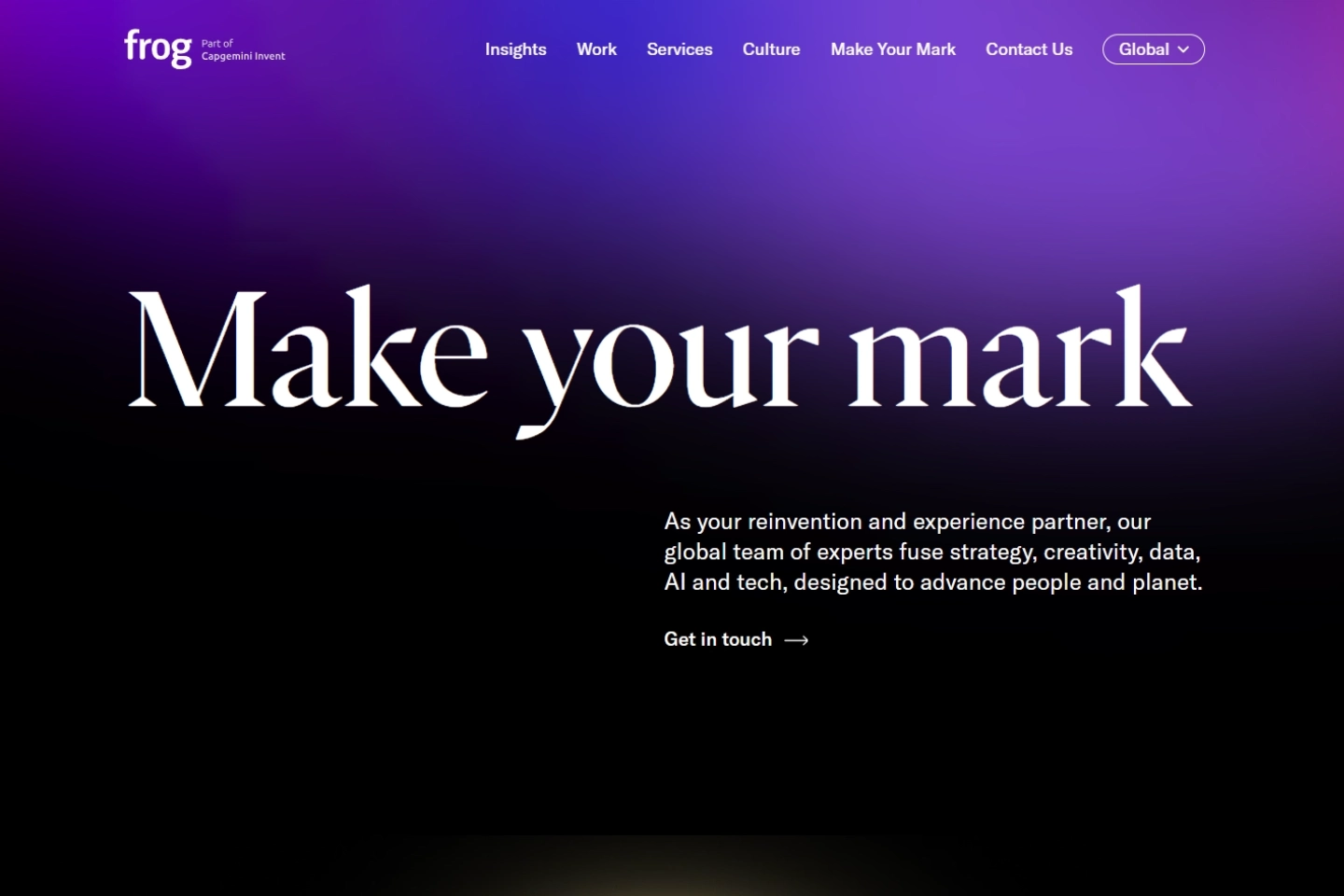
Location: San Francisco Bay Area presence, global studios | Founded: 1969 | Team size: Large, enterprise-scale | Best for: Global brands seeking creative range across physical and digital touchpoints | Notable clients: Nestlé, Apple, Microsoft, Sony, Disney, GE
Website: frog.co
Frog has shaped product and brand design since 1969, with a legacy that includes early visual language for Apple and Sony and well-known brand work for Nestlé. Now part of Capgemini Invent, the firm spans product design, service design, brand experience, and business innovation, making it a broad partner for large organizations.
Why they stand out: Frog balances creative ambition with enterprise-scale delivery. Global studios bring varied cultural perspectives, and the firm moves fluidly between physical products, digital experiences, and brand systems. For a multinational that needs design strategy and execution across many markets, that reach is a real asset.
Frog’s San Francisco Bay Area roots run deep, and its long history with hardware and software gives it unusual range across web design, product, and service design. The firm pairs research with strategy on large programs, which suits organizations treating design as a lever for digital transformation rather than a cosmetic refresh.
What to know before hiring: Frog is a large consultancy, which brings process and overhead that startups may not want. The strategic, brand-led approach is powerful for digital transformation programs but can be more than a small team needs for a focused interface build. As with most large firms, clarify who from the senior team will actually work your design project.
5. Neuron
Enterprise Software Specialists
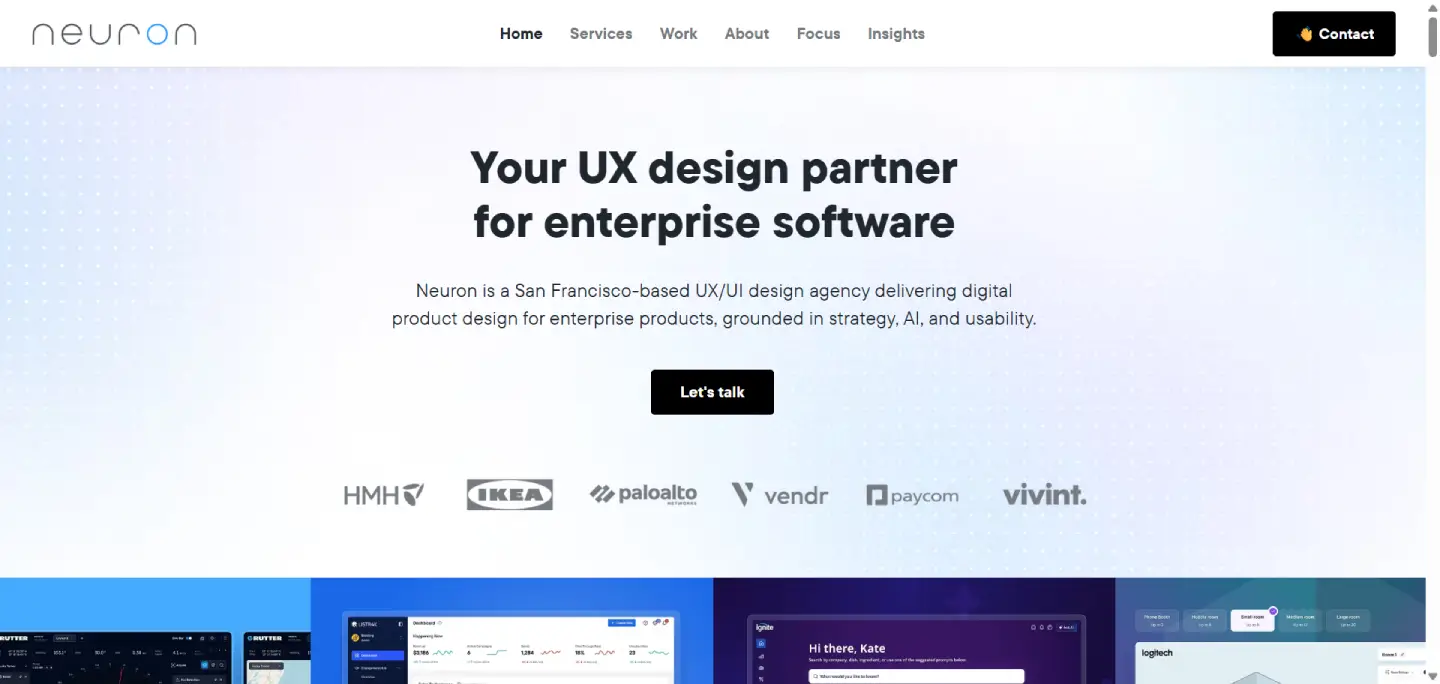
Location: 650 California Street, San Francisco, CA 94108 | Founded: Boutique, established roughly a decade ago | Team size: Small, specialized | Best for: Complex B2B and enterprise software, plus AI-driven product design | Notable clients: Houghton Mifflin Harcourt, IKEA, Vendr, Paycom, AcuityMD
Website: neuronux.com
Neuron is a San Francisco UX design agency built specifically for enterprise software. The team concentrates on product strategy, UX/UI design, and DesignOps for complex B2B products in areas like finance, analytics, CRM, and project management. It is a boutique firm that trades breadth for depth in a demanding niche.
Why they stand out: Enterprise tools are a hard design problem, and Neuron leans into it. The firm turns dense workflows into intuitive workspaces, builds robust design systems, and offers an embedded ux design team model that larger agencies often cannot. Its work has been featured in Fast Company, and it has earned recognition as a top UX design agency in San Francisco.
Neuron keeps its San Francisco team small on purpose, which means clients work directly with senior designers rather than account managers. The firm also publishes a UX maturity benchmark drawn from more than 175 organizations and brings that data into client work, giving B2B teams a clear read on where their UX/UI design stands and what to fix first.
What to know before hiring: Neuron’s focus is its strength and its limit. If you need consumer brand work, broad marketing design, or large-scale creative campaigns, this is not the fit. For B2B and enterprise software teams that want specialists who understand their world, Neuron is a strong, strategic partner.
What UX Design Agencies in San Francisco Actually Cost
Pricing varies widely, so set expectations early. San Francisco UX agencies commonly charge $40,000 to $150,000 for a product redesign, and typical budgets for a broader San Francisco UX project range from $40,000 to $250,000. Full-cycle product strategy engagements can exceed $250,000.
Hourly rates for UX design in San Francisco generally run from $150 to $300. Small, tightly scoped projects can start around $10,000, while large enterprise programs can exceed $1 million. Most agencies use project-based or retainer pricing models, and many offer flexible engagement models to match your budget and project scope.
Do not read price as a proxy for quality. A boutique team can outperform a large firm on a focused brief, and the opposite holds true at enterprise scale. Scope the work honestly, then find the tier that fits.
What you are paying for is not hours but outcomes. Strong UI can lift conversion rates by up to 200%, and good UX can push that higher still.⁴ Forrester’s widely cited research puts the return as high as $100 for every $1 invested in UX.⁵ Against numbers like that, the cost of a well-run design project tends to dwarf the fee. The trick is matching spend to scope rather than chasing the biggest name.
Startups vs. Enterprises: Match the Agency to Your Stage
The right partner often comes down to your stage. Agencies in San Francisco serve both fast-growing startups and large enterprises, but few do both equally well. A startup usually needs speed, a sharp first version, and a UX design agency that can ship a credible product against tight deadlines. An enterprise usually needs governance, durable systems, and a team comfortable navigating complex stakeholders.
For early-stage teams, look for rapid prototyping, a lean process, and senior designers who can make calls without a committee. A San Francisco UX design agency that has launched venture-backed products understands the pressure of a fundraise timeline. Specialized firms in this market have helped clients raise meaningful follow-on funding after a focused redesign, which is the kind of outcome a startup should expect to discuss.
For enterprises, weigh depth of process, security posture, and the ability to support ongoing ux design after launch. Large organizations benefit from a UX design agency that builds reusable systems and trains internal client teams, so the work compounds instead of expiring at handoff. The same San Francisco market serves both ends. The skill is matching the firm to the moment, not hiring the biggest brand and hoping.
Red Flags to Watch For When Hiring in San Francisco
A few warning signs separate a smooth design project from a costly one. The first is a portfolio heavy on visuals but light on outcomes. If a UX design agency cannot point to adoption, conversion, or retention numbers, treat the pretty screens with healthy skepticism.
The second is a thin validation practice. Evidence-based design depends on user testing and real user insights, and a firm that skips that step is guessing. Ask any San Francisco agency how it gathers user feedback and turns it into design solutions before money changes hands.
The third is vague pricing. Reputable San Francisco teams explain their engagement models, project scope, and project management approach up front. If you cannot get a straight answer on cost or timeline, that ambiguity rarely improves once you have signed.
What Sets San Francisco UX/UI Design Apart in 2026
A few forces shape how the best UX/UI design gets made in San Francisco right now.
The first is AI. Nearly every serious UX design agency in the city now folds generative tools into research, prototyping, and interface work. That compresses timelines and raises the bar on craft.
The second is the shift beyond the screen. Voice, gesture, and multimodal interfaces are moving from novelty to expectation. UX/UI design here increasingly spans devices rather than a single app, which rewards teams with genuine range.
The third is measurement. Clients expect UX/UI design tied to outcomes, so agencies instrument their work and report on adoption, conversion, and retention. The era of design as a pure cost center is over.
The fourth is systems thinking. Mature teams ship reusable design systems and clear documentation so a client’s own designers can extend the work. Good UX/UI design now arrives as tooling, not just static files.
For buyers, the practical takeaway is simple. Ask a prospective UX/UI design partner how it uses AI responsibly, how it designs across modalities, and how it proves impact.
The answers separate firms riding the trend from firms leading it. In a market as deep as San Francisco, that distinction is worth the extra diligence.
How to Choose the Right UX Design Partner
Not every agency will fit your business, and a surprising share simply will not match your goals, industry, or stage. The point of a comparison like this is to help you self-select, not to crown a single winner for everyone.
Start with fit. A UX design agency should align with your project goals and the industry you operate in. A team that lives in enterprise software thinks differently from one built for consumer apps, and that difference shows up in the final product.
Check the research practice next. Evidence-based UX depends on real user research, and the firms worth hiring invest in user testing and user feedback rather than relying on assumptions. Ask to see how a candidate agency gathers user insights and turns them into design solutions.
Then weigh the engagement model. Some teams work best as embedded strategic partners with ongoing ux design support; others excel at a defined sprint with high fidelity mockups and interactive prototypes delivered against tight deadlines. Neither is better in the abstract. The right model depends on your team and timeline.
For regulated work, confirm compliance experience. Many San Francisco agencies maintain HIPAA-compliant workflows for healthcare projects, which matters if you handle patient data. The same goes for security reviews, accessibility standards, and any industry rules that govern your product.
Finally, look at what happens after launch. The best partners offer ongoing support, design audits, and help maintaining a design system so your product keeps improving. A relationship that ends at handoff often leaves value on the table. For more on selecting the right ux design partner, our broader guide to the best UI/UX design companies in the USA goes deeper on criteria and engagement models.
The Bottom Line
The best ux design agencies in san francisco are not interchangeable, and the goal is not to find the single highest-ranked name. It is to find the team whose strengths map to your problem. Punchcut leads this list for AI and emerging-technology work, IDEO for systems-level innovation, Clay for brand-plus-product, Frog for global creative scale, and Neuron for enterprise software depth.
Match the agency to your project scope, industry, and stage, then pressure-test their research practice and engagement model before you sign. Strong UX is one of the highest-return investments a digital product can make, and San Francisco gives you genuine depth to choose from. Pick the partner that fits, not just the one with the loudest reputation.
A short final note on method. We placed our own studio first, and we tried to earn that spot by holding every entry to the same format and naming our own limits as plainly as anyone else’s. Use the comparison as a starting point, then talk to two or three firms directly. The right fit reveals itself fast in a real conversation.
If you want to talk through where your product fits, you can see Punchcut’s work or get in touch directly.
Frequently Asked Questions
This comparison ranks Punchcut, IDEO, Clay, Frog, and Neuron. Punchcut leads for AI and emerging-technology work, while the others excel in systems innovation, branding, global scale, and enterprise software respectively.
Most San Francisco UX projects range from $40,000 to $250,000, with hourly rates of about $150 to $300. Small projects can start near $10,000, and full product-strategy engagements can exceed $250,000.
Prioritize portfolio evidence, a real user research practice, and industry fit over reputation alone. Confirm the engagement model, compliance experience where needed, and whether the firm offers ongoing support after launch.
Yes. Agencies in San Francisco serve fast-growing startups and large enterprises alike, and many build scalable design systems and offer flexible engagement models to match different budgets, timelines, and project scopes.
References
- https://www.mordorintelligence.com/industry-reports/ui-ux-market
- https://www.mckinsey.com/capabilities/tech-and-ai/our-insights/the-business-value-of-design
- https://www.eficode.com/blog/achieving-roi-with-ux-design
- https://www.eleken.co/blog-posts/14-impressive-ux-statistics-to-prove-the-value-of-great-design
- https://maze.co/blog/ux-statistics/